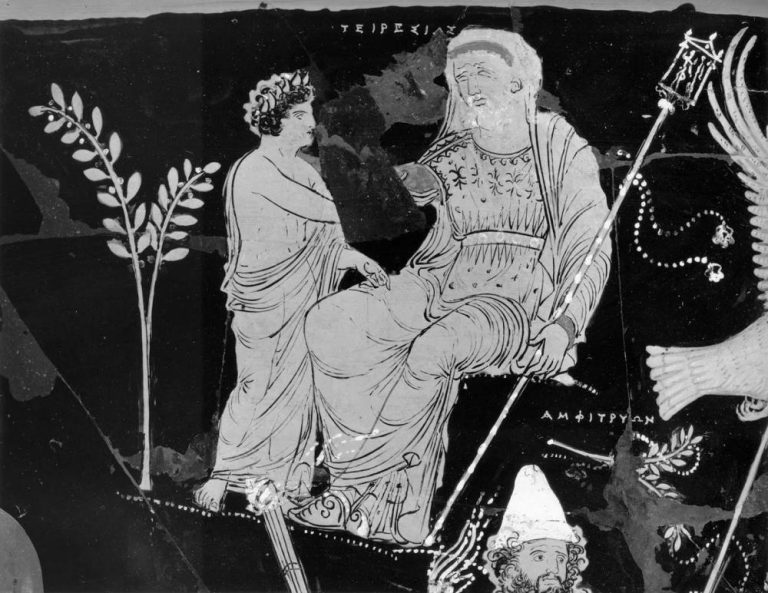
There are plenty of answers to the question why one should learn Latin and Ancient Greek. We often hear that ancient languages develop analytical and problem-solving skills, and that they open the door to other languages. Former UK prime minister Boris Johnson is a polarising figure, and his penchant for quoting Latin in the House of Commons was certainly neither clever nor inclusive, but he makes a fair point here:
Latin and Greek are great intellectual disciplines, forcing young minds to think in a logical and analytical way. They are also a giant universal spanner for other languages. Suppose your kid scrapes her knee on holiday in Italy. You are much more likely to administer the right first aid if you know that caldo means hot rather than cold – as you will, if you know Latin. i
But some might object that you can develop analytical skills by studying mathematics, and that Italian, French or Spanish are no worse a stepping stone to other Romance languages than Latin is. That is true. What is more, recent research i asks to what extent the benefits associated with studying Latin are due to the students’ superior pre-existing abilities (preselectivity), as opposed to cognitive transfer effects elicited by studying the language. The researchers challenge the notion that cognitive transfer effects can be attributed to Latin studies, reporting that “only one variable, vocabulary, demonstrated a trend in line with cognitive transfer benefits”.
Yet there are plenty of other answers, weighty and relevant ones, to the question of why we should study ancient languages. So what do researchers, Oxford Latinitas students, and high-profile Classics graduates have to say?
- It subtly rewires how you read English
Latin makes English vocabulary easier to understand, especially academic, scientific and professional terminology. More than half of all English words come from Latin. The Department of Classics at the University of Illinois highlights how studying Latin expands your English vocabulary and helps you understand how words are formed: “Students of Latin see immediate benefits to their spoken and written English” i. On this measure, research has proven that studying Latin gives you an edge: native English-speaking students who had studied Latin for two years performed better on English spelling tests than students who studied a modern foreign language for a similar amount of time i. This brings us to our next point, which holds true not only for native speakers of English.
- Latin and Greek train you to pay attention to how language works
Studying Latin and Greek grammar – cases, tenses, agreement, syntax – helps you think about how languages work in general. Coping with a relatively free word order, unpacking key information from case endings and verb forms, reflecting on a text and reading it slowly: all of this builds metalinguistic awareness, the ability to notice and analyse the structure of a language. This is precisely the effect discussed in a large-scale 2024 study, which showed that “Latin students demonstrate advantages in intelligence measures, enhanced native language proficiency and increased meta-linguistic awareness, compared to their non-Latin peers” i.

- A real point of distinction in admissions and in a CV
Even if you make a career outside the discipline, Latin remains a rare and striking enough choice to signal focus and tenacity. Lord Evans of Weardale, former Director General of MI5, describes his own experience and that of his colleagues:
“My Classics degree gave me a wide grounding in the humanities, particularly with the languages which require discipline and concentration and help you to crystallize your thoughts.” i
In a 2010 interview, while still in post, asked about connections between his education and his current role, he replied: “MI5 needs people with good intellectual skills, the ability to spot connections, the ability to absorb and assess a variety of material. Natural ground for a classicist.” He added: “There has been something of a classical tradition in the intelligence world. The retired officer who first interviewed me for a job in MI5 was a classicist.” i.
- Ancient languages connect you directly with ancient literature
This argument holds for academic researchers and lovers of classical literature alike. Translation is always interpretation: if you read a text in translation, you can never fully grasp the original, because the translator’s shadow stands behind the poet or writer, and sometimes in front of them.
Our students often tell us that they started learning Latin or Ancient Greek for academic reasons. Here, for example, is feedback from one of our 2025 students:
Ancient Greek Beginners I was one of the best investments I’ve ever made towards my academic goals. To be able to go from nothing to confidently reading in two weeks is incredibly empowering.
Yet meeting an ancient text face to face, and entering into a living conversation with an ancient author, becomes something more. In 2026 the same student wrote to us that his motivation had shifted over time from extrinsic to intrinsic — a particularly valuable development:
I took ancient Greek courses from Oxford Latinitas and it’s super great. My motivation from philosophy has now become love in this challenging but beautiful language!
British writer and journalist Charlotte Higgins recalls why she chose to study Classics: “I fell in love with the stories. The world of Catullus and Euripides was so familiar and yet so thrillingly alien, so hard to decode.” i
These are languages in which you can read an astonishingly varied range of texts: love poetry, satire, lyric poetry, philosophy, letters, epic poetry, graffiti, Christian writings, medieval anecdotes, scientific treatises, tales of fantastical voyages, and more.
- Latin is worth learning simply because it is fascinating and brings joy
If you’re looking for an intellectual hobby, a new pursuit for your retirement, an escape from the daily grind, the pleasure of spending time with kindred spirits, or counsel and consolation from ancient authors, if you want to take a closer look at the people of the ancient world and see their humanity, you won’t be the only one to find all this in ancient languages. Here, for instance, is what the British actor Tom Hiddleston, who holds a degree in Classics from Cambridge University, has to say:
I feel less alone in the world when I study the Classics, because actually the human condition and the experience of being alive as a human being hasn’t changed. Sure, our technologies have changed. They didn’t fly airplanes then or have smartphones then. But they had families and they lived and they loved and they looked after each other […] And so their hopes and fears, and the essential essence of human beings was exactly the same i.
P.S. Latin and Ancient Greek are dead languages, which means that they are no longer developing organically. But learning them does not have to be a dead experience. In recent decades the direct (natural) method, which relies on contextual induction, has seen a surge in popularity. Teachers are refining the way they teach Latin and Ancient Greek, using games and songs, discussing pictures and texts, and encouraging students to speak and write. All of this prepares students to read ancient authors not just as well as the traditional grammar-translation method does, but better!
Here is what our students say about it:
This was an excellent introduction to Ancient Greek that brought me to reading quickly. (Anonymous)
I loved the active method for learning Latin, it has really helped me see the language in action and be able to understand the sources in my research in a way that makes them come to life. (Lara Mudarra)
It’s a great community of people eiusdem farinae (literally ‘of the same flour’, or, as we’d say in English, cut from the same cloth).