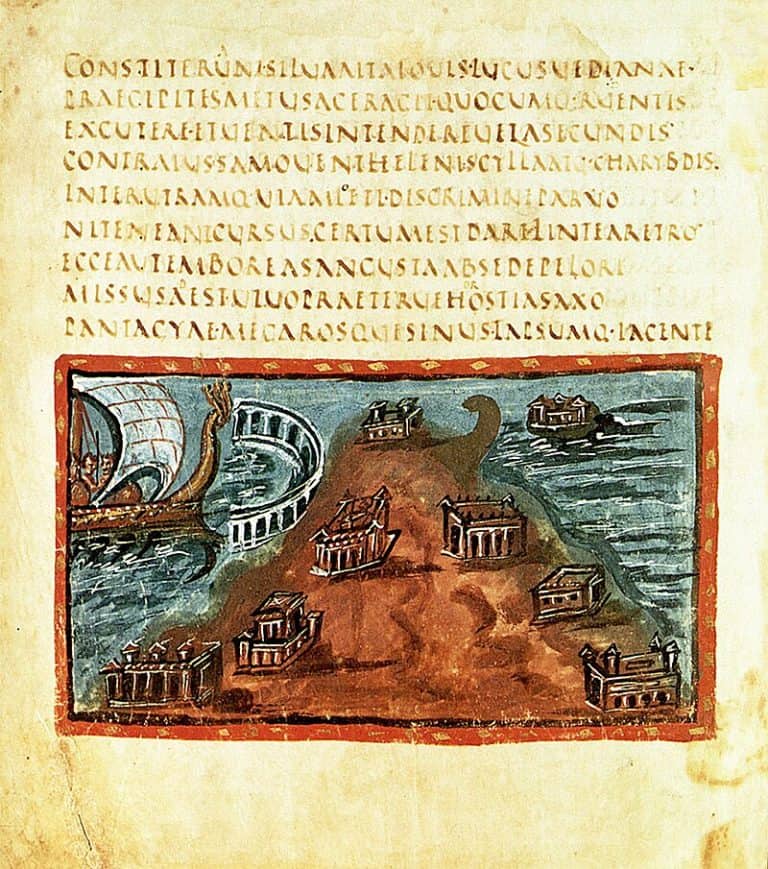
At the beginning of the third book of Ovid’s Tristia, his book travels to Rome. It visits places that were dear to the poet himself, places he by that point had already despaired of ever seeing again.
The book looks at Rome’s political and religious centre – the Forum and the ancient temples of Vesta and Jupiter –, and then sets off for the places dearest to the poet: the libraries. There, it searches for its brothers, Ovid’s other books.
On this nostalgic journey, the book – the author’s longing gaze – visits all three public libraries that existed in Rome at the time. It begins with one of the two libraries established by Augustus. This was the library at the Temple of Apollo Palatinus, adorned with columns of African marble and statues of Danaus and the Danaids. It housed both Greek and Latin books, “all those things which the men of old or of modern times conceived in their learned souls are free for the inspection of those who would read” (Ov. Tr. III,1, 63-64, translated by A. L. Wheeler Latin text).
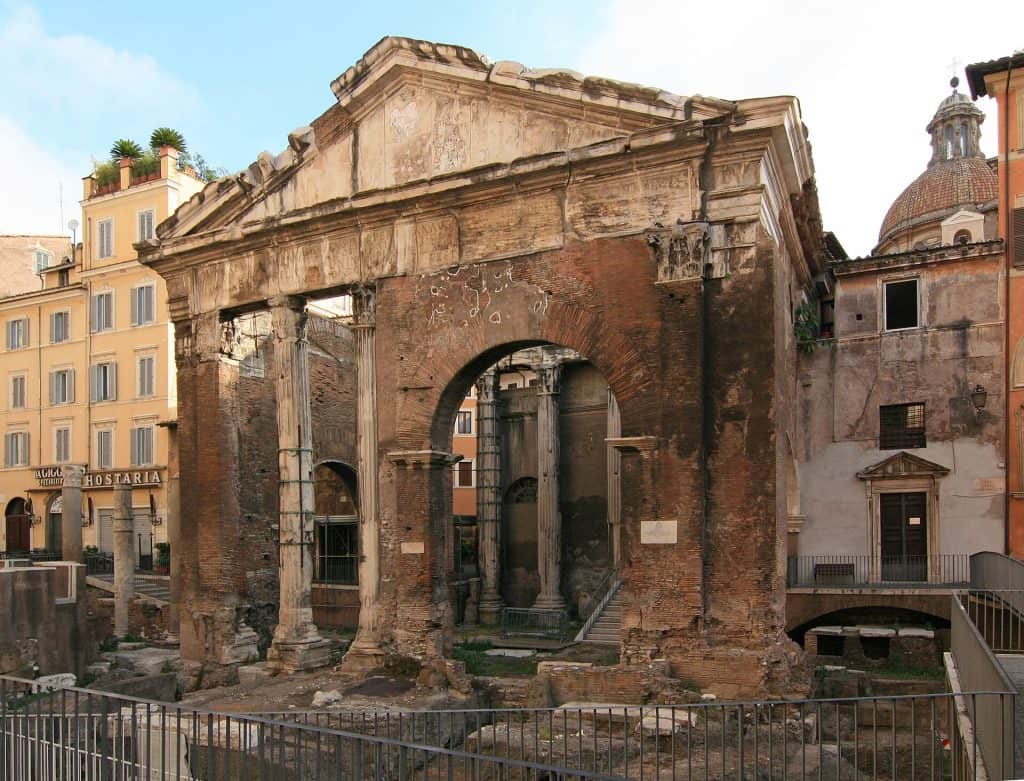
The book then moves on to another temple, close to a theatre (Altera templa peto, uicino iuncta theatro, Ov. Tr. III, 1, 69) – the library founded either by Augustus or by Octavia herself in the Portico of Octavia, adjacent to the Theatre of Marcellus.
The third and final library mentioned by Ovid was founded by Asinius Pollio in 39 BC at the Temple of Liberty. It was the first public library in Rome:
Nec me, quae doctis patuerunt prima libellis,
atria Libertas tangere passa sua est.
(Ov. Tr. III, 1, 71-72: “Nor did Liberty allow me to touch her halls, the first that were opened to learned books.”)
In Ovid’s time, public libraries in Rome were still a relatively new part of the city’s amenities. Caesar had been the first to order the establishment of a public library containing Greek and Latin texts. This is mentioned by Suetonius in his Life of Caesar and by Isidore of Seville in his Etymologies (Suet. Div. Iul. 44.2; Isid. Etym. VI).
Before this, intellectuals who lacked the means and resources to build their own libraries had to borrow books from friends, exchange them, or use the libraries of their patrons, as we know, for instance, from Cicero’s letters.
Caesar entrusted the organisation of the first library to Marcus Varro, but the project was not completed because of Caesar’s death. As a result, the first public library in Rome was the one established by Asinius Pollio. It contained both Greek and Latin books. In the atrium, there were also – an important detail, as it marked the beginning of a tradition that most libraries still follow today – portraits of the authors (Primum autem Romae bibliothecas publicavit Pollio, Graecas simul atque Latinas, additis auctorum imaginibus in atrio, Isid. Etym. VI).
Here we see an important feature of Roman public libraries: they were associated not only with knowledge, but also with fame and glory. In his Natural History (35.2), Pliny the Elder mentions libraries specifically in connection with the honour attached to portraits. He calls portraits “a new invention” (novicium inventum) and writes:
“Not only do we consecrate in our libraries, in gold or silver, or at all events in bronze, those whose immortal spirits hold converse with us in those places, but we even go so far as to reproduce the ideal of features, all remembrance of which has ceased to exist; and our regrets give existence to likenesses that have not been transmitted to us, as in the case of Homer, for example” (translated by J. Bostock and H. T. Riley, Latin text).
Pliny also reports (7.31) that M. Varro was the only person to have been honoured with a statue during his lifetime in that very library founded by Asinius Pollio.
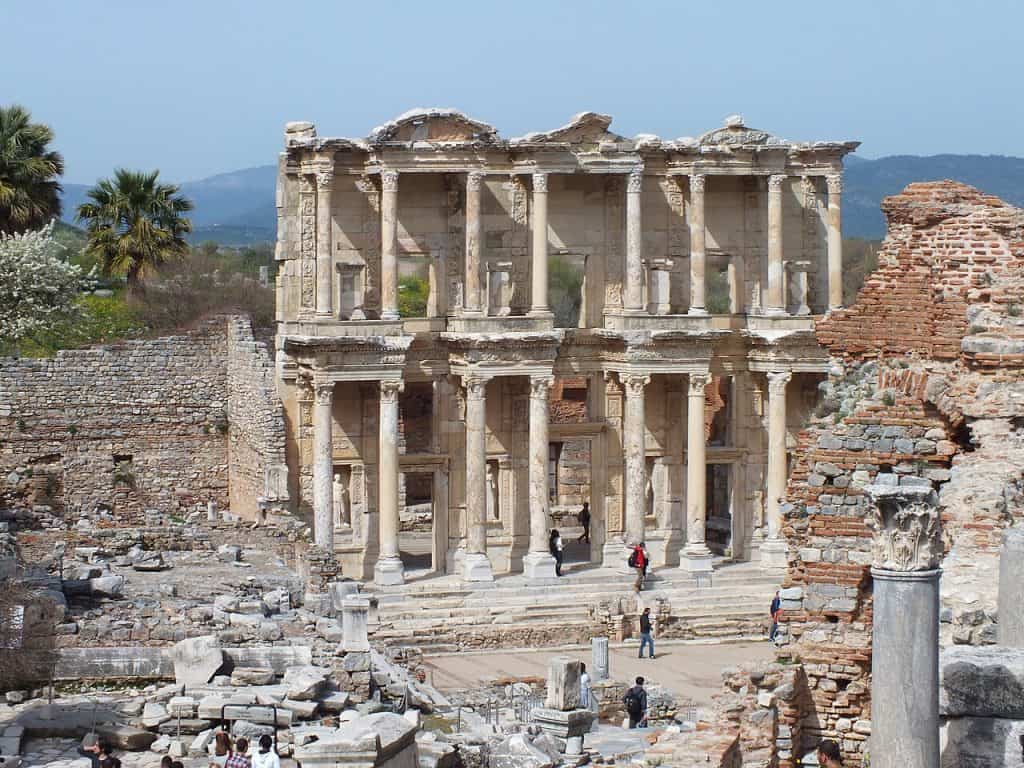
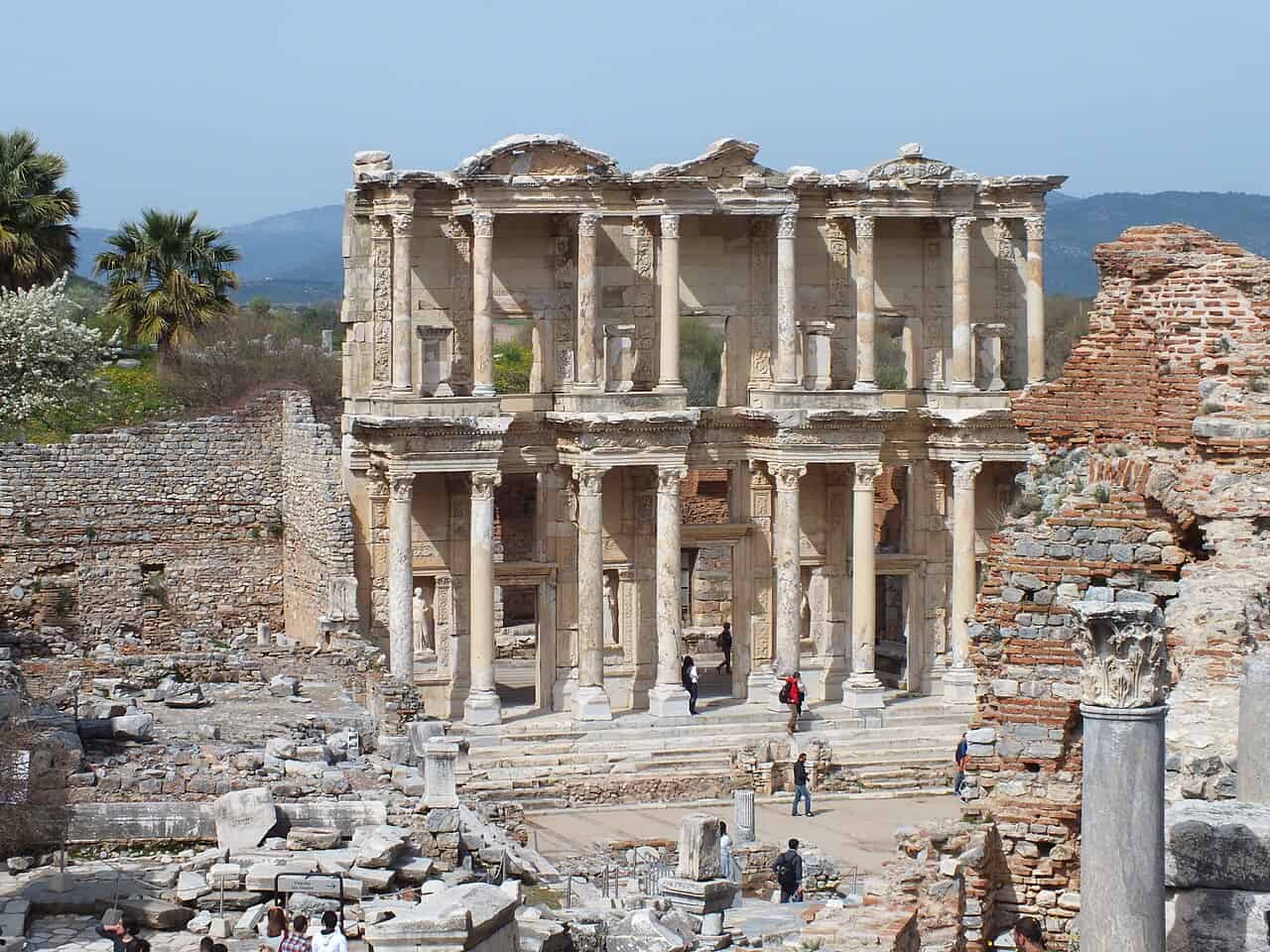
Another example of the connection between the library, memory and eternal fame is the Library of Celsus in Ephesus (modern-day Turkey). The Library of Celsus was built in AD 115–25 by Tiberius Iulius Aquila Polemaeanus in honour of his father, Tiberius Iulius Celsus Polemaeanus, whose tomb was located at the back of the library. The son made the right choice: the Library of Celsus, magnificent and richly decorated, became not only a repository for a vast number of books, a centre of intellectual attraction, and an architectural marvel, but also a guarantee of the eternal memory of both father and son.
Part of the interior and much of the façade have survived or been reconstructed, and you can see and visit it with our experienced teachers on our Greek trip at the end of September. You can sign up here: Ancient Greek Immersion Trip
Sources and Further Reading
- Keith Dix. “Public Libraries” in Ancient Rome: Ideology and Reality. Source: Libraries & Culture, Vol. 29, No. 3 (Summer, 1994), pp. 282-296
- George W. Houston. Inside Roman libraries: book collections and their management in antiquity. The University of North Carolina Press 2014