Anyone learning Latin with Hans Ørberg’s excellent Familia Romana meets a cheerful little dog called Margarita in Chapter X. Her name means ‘Pearl’, and it is no accident: Margarita is plump and white, just like a pearl. But is that the only reason she bears this name? And do we actually know what the Romans called their dogs?
As it happens, we do. Two kinds of sources shed light on the question: references in literature and inscriptions. Both of them mention a dog named Margarita.
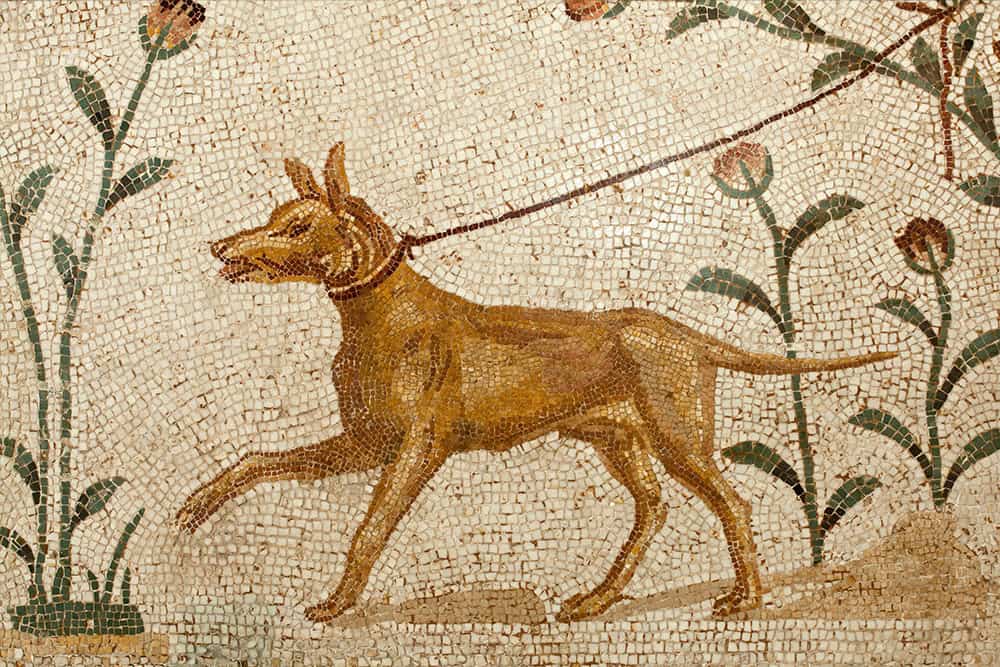
The Romans kept dogs for a variety of purposes. Columella, who wrote in the early Imperial period, describes in his treatise On Agriculture the types of dog that are useful on a farm.
There are three different reasons for procuring and keeping a dog. One type of dog is chosen to oppose the plots of human beings and watches over the farm and all its appurtenances; a second kind for repelling the attacks of men and wild beasts and keeping an eye at home on the stables and abroad on the flocks as they feed; the third kind is acquired for the purposes of the chase, and not only does not help the farmer but actually lures him away from his work and makes him lazy about it. i
Columella takes a sceptical view of hunting dogs, since breeding and keeping them served the leisure of wealthy Romans rather than the practical needs of farming.
His treatise offers a wealth of advice on every aspect of country life, and he even addresses the question of what to name a dog.
Dogs should be called by names which are not very long, so that each may obey more quickly when he is called, but they should not have shorter names than those which are pronounced in two syllables, such as the Greek Skylax (puppy) and the Latin Ferox (savage), the Greek Lakōn (Spartan) and the Latin Celer (speedy), or, for a bitch, the Greek Spoudē (zeal), Alkē (valour), Rhōmē (strength), or the Latin Lupa (she-wolf), Cerva (hind) and Tigris (tigress). i
Virgil mentions another name for a shepherd’s dog in his Eclogues (3.17–18), although it does not follow Columella’s two-syllable rule:
Did I not see you, rogue, in ambush lie
For Damon’s goat, while loud Lycisca barked?i
Lycisca appears to be a counterpart of Lupa. The Greek λυκίσκη, the feminine of λυκίσκος, is built on the root λύκος, meaning ‘wolf’, modified by the diminutive suffix -ίσκος/-ίσκη. Lycisca is thus ‘little she-wolf’. Isidore of Seville tells us that ‘dogs born of wolves and dogs, when they happen to mate with one another, are called lycisci’ i
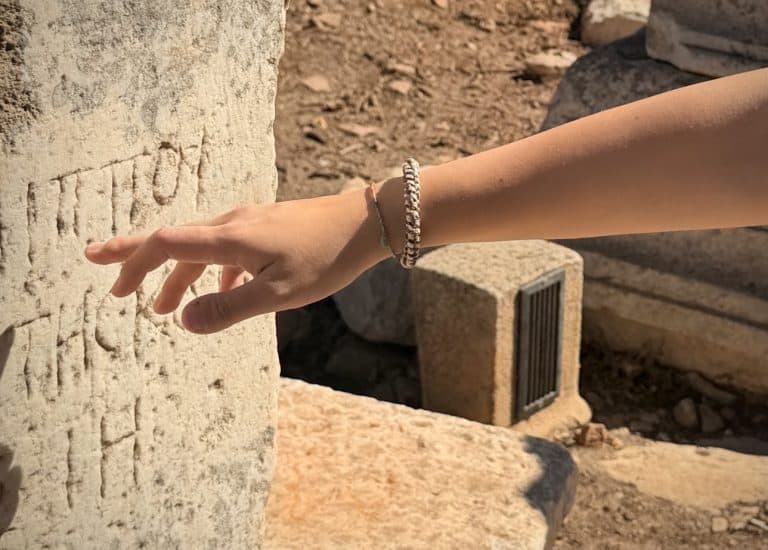
Yet the Romans, much like people today, kept dogs not only for work but also for companionship and pleasure. It is these pampered, much-loved pets that appear in literature: their owners commissioned poems and portraits of them, mourned them when they died, and set up tombstones in their memory. Those tombstones bore inscriptions, which are a gift to anyone studying Roman culture!
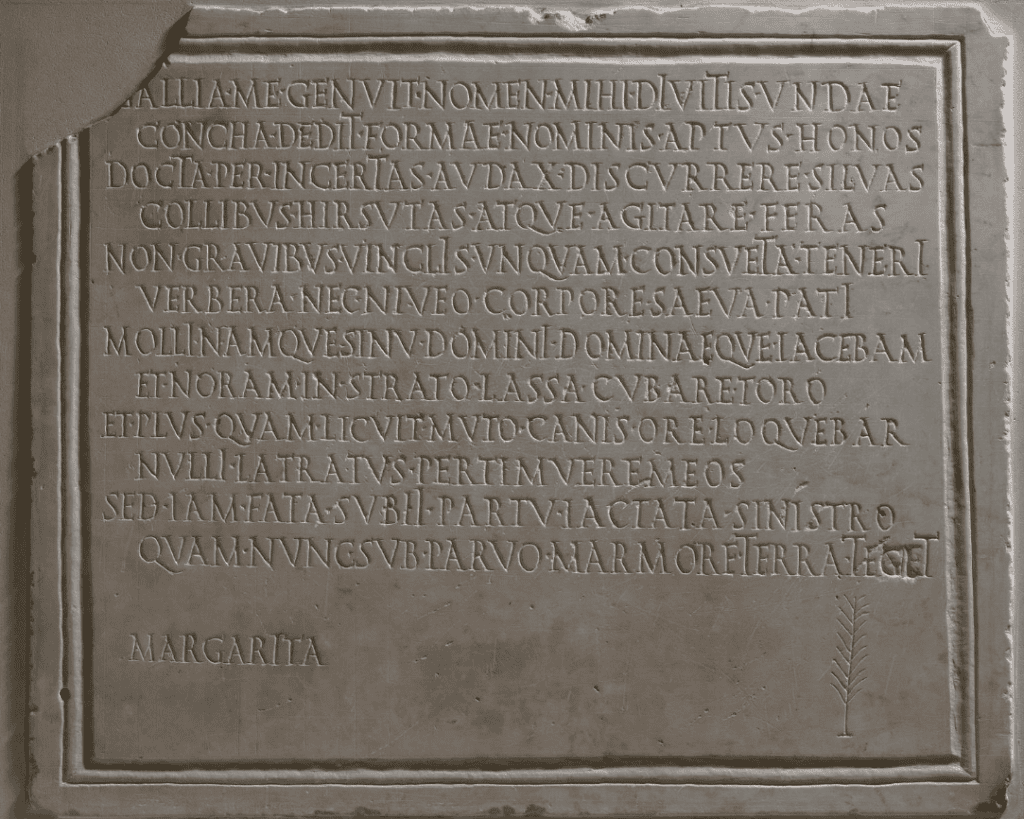
One of the most elegant epitaphs to survive belongs to a dog named Margarita. It is written in the dog’s own voice and tells of her origins, her life and her character:
“Gallia gave birth to me, the name of the ocean’s wealth
a shell gave me; the honour of the name befits my beauty.
Learned in running bravely through dim forests
and in flushing out furry beasts in the hills,
I was not accustomed ever to being held in heavy chains,
nor to suffering savage beatings on my snowy body.
For I would lie on the soft lap of my master and mistress,
and I knew how to sleep on a made bed when I was tired,
and I spoke more than permitted with my speechless canine mouth:
nobody was very afraid of my barks.
But now I have died, cast down by giving ill-favored birth,
and now the earth covers me under a small marble.” i
As Robert Matera, who has studied this inscription, observes, ‘Pearl shows off her doctitude with clever rhetorical and metrical devices, intertexts with famous poems, and engagement with metapoetic discourses’. Her name reflects her worth and refinement: she is a true pearl among dogs.
Martial’s epigrams also include epitaphs for dogs. Here, though, the poet is not a grieving owner but a writer working to commission, earning his living by composing epitaphs for other people’s pets. The epitaph for Lydia, a hunting dog and cherished companion, follows the conventions of the genre (venatrix, silvis aspera, blanda domi, / Lydia dicebar, 11.69). In his poem in praise of the lapdog Issa, however, Martial allows himself a touch of irony. In describing her gentleness, delicacy and good manners he not only conveys her owner’s rapturous admiration for his pet, but gently mocks him at the same time:
‘Such modesty resides in this chaste little animal; she knows not the pleasures of love; nor do we find a mate worthy of so tender a damsel.’ i
A funerary inscription is dedicated to just such a house dog, and it also records her name, Myia. She lived with her mistress and shared her bed. Though she was of gentle temperament, she would bark to drive away anyone else who wished to lie down beside her mistress. The Greek Μυῖα means ‘fly’. Why, then, was the little dog given this name? The epitaph does not tell us. We may guess, however, that she was small, dark and lively. The Greeks had a saying that goes back as far as the Iliad (17.570): μυίης θάρσος, ‘the courage of a fly’, meaning boldness out of all proportion to one’s size.
We cannot list here every dog’s name found in inscriptions and literature. But we cannot leave out one more well-known passage about pampered pets, in which the name Margarita appears once again, and once again belongs to a small, plump dog. The passage comes from Petronius’ Satyricon (64). Croesus, Trimalchio’s young favourite, has a little dog called Margarita, which he feeds during the banquet. Seeing this, Trimalchio orders his beloved Scylax to be brought in. Scylax is Margarita’s exact opposite: a huge guard dog kept on a chain. Trimalchio teases Croesus by declaring that no one in his household loves him more than Scylax does:
‘Nemo,’ inquit, ‘in domo mea me plus amat.’
The boy takes offence, perhaps because Margarita has received no such praise, or, more likely, because he himself has not.
‘The favourite, indignant at this lavish praise of Scylax, deposited the puppy on the floor, urging her to attack. Scylax, of course, filled the room with the most dreadful barking, in the manner of dogs, and nearly tore Croesus’ little Pearl to pieces.’ i
So when Ørberg named his plump little dog Margarita, he was following a genuinely Roman tradition. Petronius’ Margarita, as it happens, was black, but the name, it seems, suited any small, round and much-loved companion. Pearls, after all, come in more than one colour.